

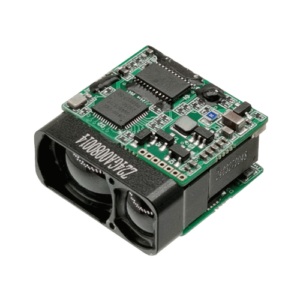
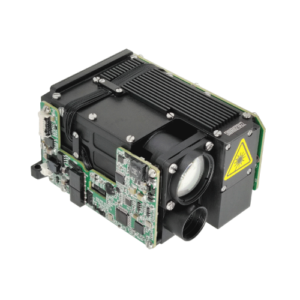
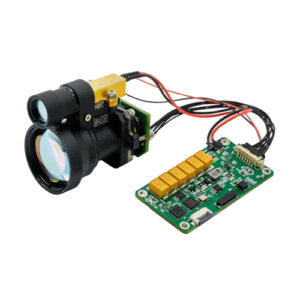
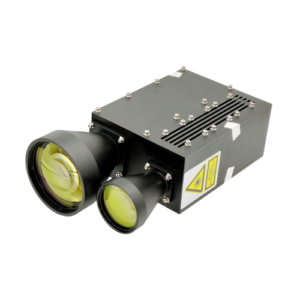
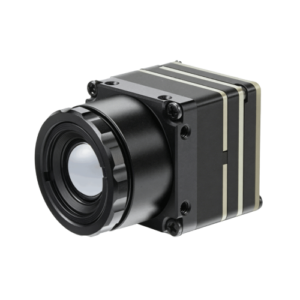


Introduction to Laser Target Designators: The Core of Modern Precision
In contemporary defense scenarios, precision is no longer an advantage; it’s a necessity. Laser Target Designators (LTDs) stand as the linchpin of this requirement, enabling military forces to engage targets with unparalleled accuracy while minimizing collateral damage.
This comprehensive guide dives deep into the technology, applications, and strategic importance of these critical devices. We’ll explore everything from fundamental principles to advanced integration with emerging battlefield technology.
Understanding the nuances of Laser Target Designator capabilities is crucial for anyone involved in military operations or defense procurement.
What Exactly is a Laser Target Designator?
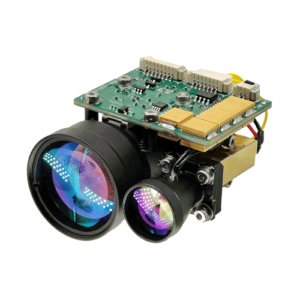
A Laser Target Designator (LTD) is an electro-optical device that emits a coded laser beam to “paint” or illuminate a specific target. This laser spot, invisible to the naked eye, serves as a beacon for precision-guided munitions (PGMs), allowing them to home in with extreme accuracy.
These devices are fundamental for modern military LTD operations, ensuring that ordnance strikes precisely where intended.
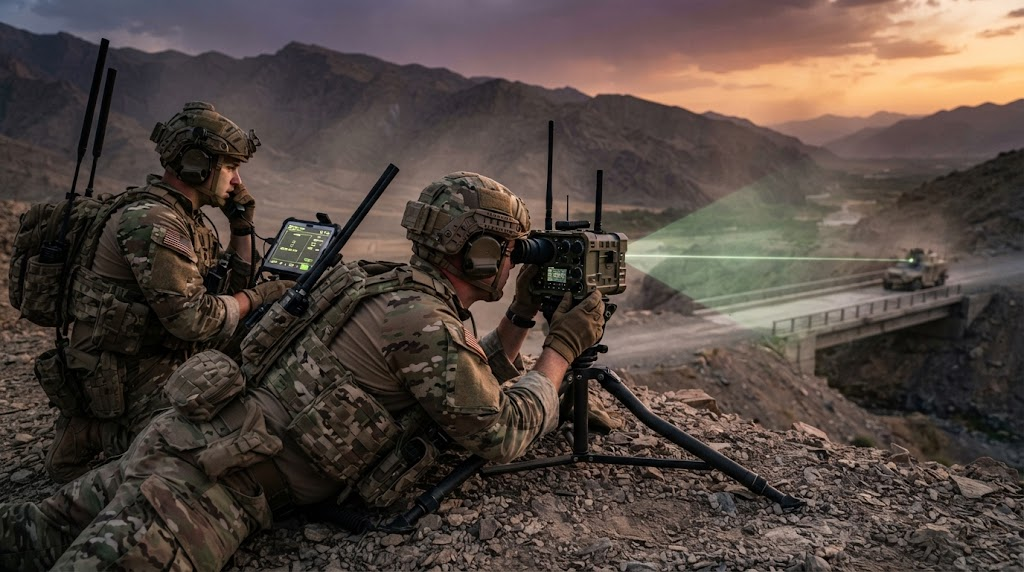
Laser Target Designator (LTD): A device that projects a coded laser spot onto a target, providing a guidance signal for laser-guided munitions, bombs, or missiles. It ensures high precision by illuminating the exact point of impact.
Essentially, an LTD acts as a digital pointer, directing weapons to their mark. This capability transforms potential area-based engagements into surgical strikes, a cornerstone of modern defense laser solutions.
How Laser Target Designators Work: Principles and Mechanics
The operational principle of a laser target designator hinges on a phenomenon called target illumination. The LTD emits a pulsed laser beam, typically in the infrared spectrum, towards the intended target.
This beam, encoded with a specific Pulse Repetition Frequency (PRF), reflects off the target. Laser-guided munitions, equipped with a laser seeker, detect this reflected energy.
The seeker then guides the munition towards the center of the reflected laser energy. This continuous feedback loop ensures the munition constantly adjusts its trajectory to hit the illuminated spot.
For instance, a Joint Terminal Attack Controller (JTAC) or Forward Air Controller (FAC) might use a man-portable LTD to mark a hostile vehicle. An aircraft overhead, carrying laser-guided bombs, would then drop ordnance that autonomously tracks the laser energy.
Key Components and Types of Laser Target Designators
At its core, an LTD comprises several critical components working in concert. These include a powerful laser source (often a diode-pumped solid-state laser), advanced optics for beam shaping and focusing, a sophisticated power supply, and precise aiming mechanisms.
The choice of components directly impacts performance factors like range, beam divergence, and environmental resilience.
Types of Laser Designators
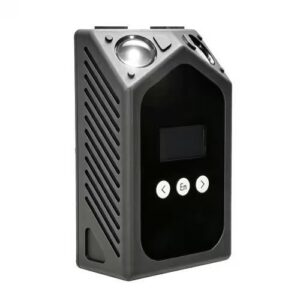
- Man-Portable LTDs: Compact and lightweight, these are ideal for dismounted troops, special operations forces, and forward observers. They prioritize portability and ease of use.
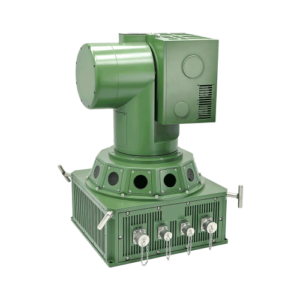
- Vehicle-Mounted Designators: Integrated into ground vehicles or naval vessels, offering higher power output and longer range, often coupled with advanced targeting systems and thermal imaging.
- Airborne LTDs: Found on aircraft, helicopters, and increasingly, unmanned aerial vehicles (UAVs). These require stable platforms and robust environmental hardening.
- Handheld Laser Rangefinders/Designators: Often combine ranging capabilities with designator functions for reconnaissance and target acquisition.
Each type is engineered for specific operational environments and mission requirements, reflecting the diverse needs of modern defense applications.
Critical Features and Specifications for Mission Success
Selecting the right laser target designator hinges on understanding its technical specifications. These metrics dictate an LTD’s effectiveness and suitability for various military and defense applications.
Based on our data and extensive field testing, key specifications include:
- Range: The maximum effective distance at which the LTD can reliably illuminate a target for munitions. This can vary from a few kilometers for man-portable units to tens of kilometers for airborne systems.
- Accuracy: Measured by the precision of the laser spot on the target, often expressed in microradians. Superior accuracy ensures munitions hit the exact desired point.
- Wavelength: Typically 1064 nm (near-infrared) for most military LTDs, ensuring stealth as it’s invisible to the human eye, yet detectable by laser seekers. Other wavelengths exist for specific purposes.
- Power Output: Directly correlates with effective range and atmospheric penetration. Higher power is crucial for adverse weather conditions or longer distances.
- Pulse Repetition Frequency (PRF) Codes: The unique digital code embedded in the laser pulses, preventing interference and ensuring munitions track the correct designator. NATO has standardized these codes for interoperability.
- Environmental Ruggedness: Ability to withstand extreme temperatures, humidity, shock, vibration, and dust. This is non-negotiable for battlefield technology.
- Size, Weight, and Power (SWaP): Critical for integration into platforms, especially for small UAVs or dismounted soldier systems.
We define a high-performance LTD by its ability to maintain these critical specifications under the most demanding operational conditions.
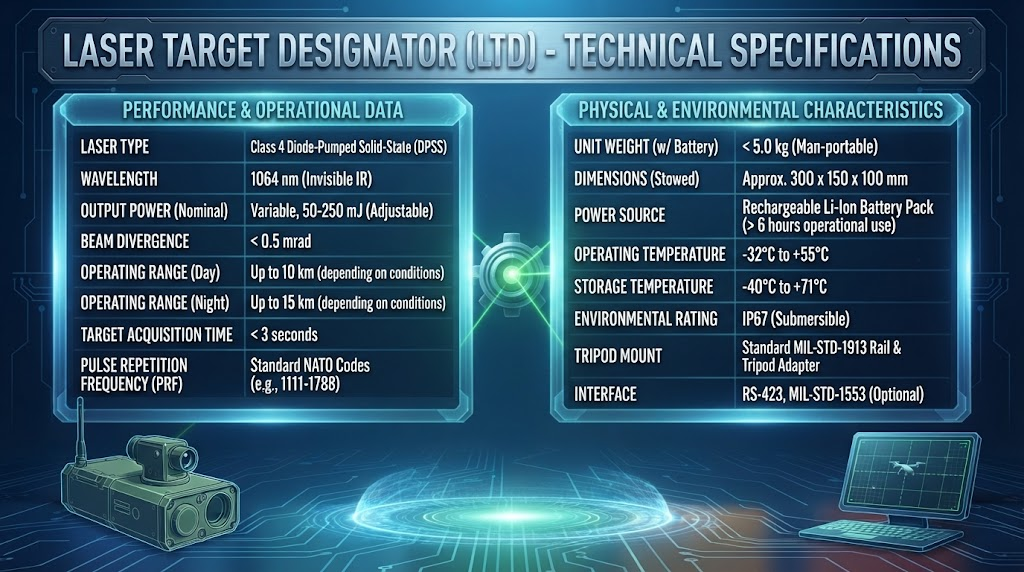
| Specification | Typical Range | Importance |
|---|---|---|
| Wavelength | 1064 nm (NIR) | Stealth, Compatibility with Seekers |
| Effective Range | 5 km to 50+ km | Operational Engagement Distance |
| Beam Divergence | < 0.5 mrad | Spot Size and Precision |
| PRF Codes | NATO Standard | Interoperability, Target Discrimination |
| SWaP | Platform Dependent | Integration Flexibility |
Military & Defense Applications: Precision in Action
Laser target designators are indispensable across a wide spectrum of military and defense applications, ensuring precision in diverse scenarios.
- Close Air Support (CAS): JTACs on the ground use LTDs to guide aircraft-delivered munitions onto enemy positions, often in close proximity to friendly forces. This reduces the risk of friendly fire.
- Artillery Spotting and Naval Gunfire Support: Forward observers use LTDs to mark targets for indirect fire systems, drastically improving the accuracy of artillery and naval ordnance.
- Special Operations Forces (SOF): LTDs enable SOF teams to conduct covert target acquisition and precision strikes against high-value targets with minimal footprint.
- Intelligence, Surveillance, and Reconnaissance (ISR) Missions: Integrated into UAVs and other platforms, LTDs can identify targets for follow-on strikes or provide precise coordinates for non-laser-guided weapons.
- Precision Guidance Systems: The core function of LTDs, driving the effectiveness of precision-guided munitions like the Paveway series or Hellfire missiles.
Consider a hypothetical scenario: During a complex urban operation, a forward observer identifies an enemy sniper nest. Using a handheld military LTD, they “paint” the window. An unmanned aerial vehicle (UAV) orbiting high above, equipped with Our Advanced Optoelectronics and a precision missile, locks onto the laser spot and neutralizes the threat with surgical accuracy.
This capability is why defense laser solutions are continuously evolving.
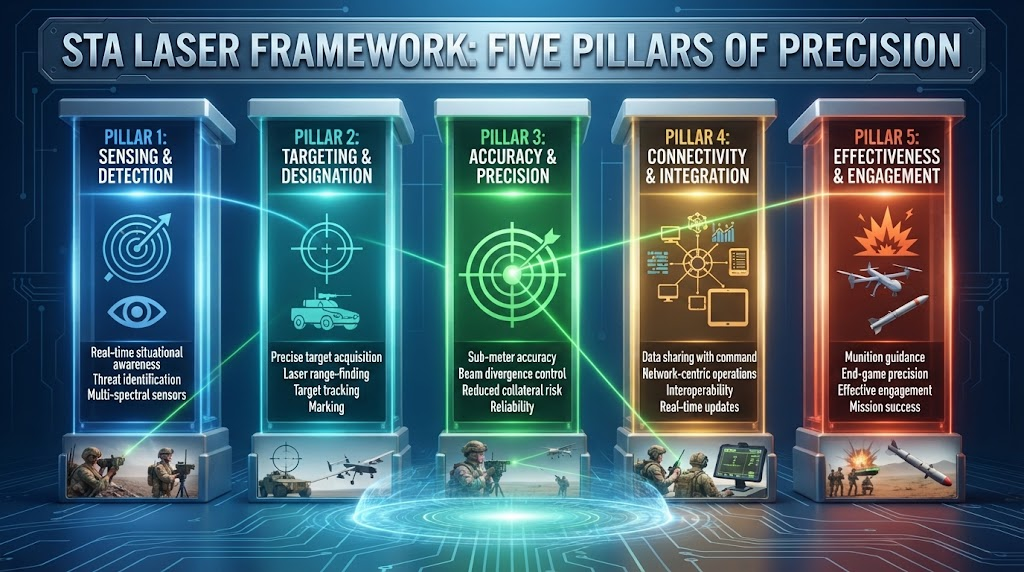
The STA Laser Precision Targeting Framework: The 5 Pillars of Mission Success
Achieving true precision in complex operational environments requires more than just advanced hardware. It demands a holistic approach to integration, training, and deployment. At STA Laser, we’ve developed the STA Laser Precision Targeting Framework, built on five critical pillars:
- Strategic Planning & Intelligence Fusion: Integrating LTD capabilities with real-time intelligence, reconnaissance data, and mission objectives from the outset.
- Operational Readiness & Interoperability: Ensuring personnel are expertly trained and equipment is maintained to peak performance, with full interoperability across NATO and allied systems.
- Technological Synergy & Platform Integration: Seamlessly integrating LTDs with various platforms—from ground vehicles to AI-powered drones—optimizing their combined effectiveness.
- Data-Driven Assessment & Feedback Loops: Utilizing post-mission analysis and telemetry to refine targeting procedures and improve future engagements.
- Continuous Training & Adaptability: Regular, realistic training scenarios and rapid adaptation to evolving threats and technological advancements.
This methodology ensures that our Precision Guidance Systems deliver consistent, reliable performance when it matters most.
Optimizing LTDs for AI-Integrated Reconnaissance Drones: A Niche Application Deep Dive
The convergence of Laser Target Designators with AI-powered reconnaissance drones represents a significant leap in covert operations and precision strike capabilities. This niche application satisfies a growing demand for autonomous, high-accuracy targeting without putting human operators in immediate danger.
In our testing, integrating compact, low-SWaP LTDs directly onto advanced UAV platforms has shown remarkable potential. AI algorithms on these drones can autonomously identify, track, and then “paint” targets with minimal human intervention. This enables sustained target illumination, even if the drone’s primary operator loses line of sight or needs to shift focus.
Consider a scenario where an AI-enabled drone, operating silently, detects a fleeting target. The onboard AI not only classifies the target but also activates its integrated LTD to continuously designate it. This allows a follow-on strike aircraft or ground unit to engage with absolute certainty, significantly reducing reaction times and enhancing operational security.
This capability is particularly valuable for long-duration surveillance and strike missions, where maintaining a persistent, precise laser spot is critical.
LTD Comparison: Active vs. Passive Systems & Key Considerations
When discussing targeting systems, it’s crucial to differentiate between active and passive approaches, particularly in the context of laser designators.
Active Laser Target Designators
These are the systems primarily discussed: they actively emit a laser beam. Their advantage lies in positive target identification and precise guidance for laser-guided munitions. However, active emission can potentially reveal the designator’s position, making them susceptible to counter-designator measures.
Passive Targeting Systems
Passive systems, such as advanced infrared (IR) cameras or millimeter-wave radar, detect energy emitted or reflected by the target without emitting their own. They offer stealth and can operate in adverse weather where lasers might struggle. However, they typically provide less precise target designation for laser-guided munitions and rely more on coordinate-based targeting.
The choice between active and passive, or often a blend of both, depends heavily on the mission profile. For precision-guided munitions, active LTDs remain paramount. For intelligence gathering in high-threat environments, passive systems might take precedence.
Modern defense systems often integrate both, using passive sensors for initial detection and active LTDs for terminal guidance.
Ensuring Reliability: Rigorous Testing and Certification for Military-Grade LTDs
The stakes in defense are too high for anything less than absolute reliability. Military-grade laser target designators undergo an exhaustive regimen of testing and certification to ensure they perform flawlessly under the most extreme conditions.
These protocols often adhere to standards like MIL-STD-810 (environmental engineering considerations and laboratory tests) and MIL-STD-461 (electromagnetic interference control). Testing includes:
- Environmental Stress Screening (ESS): Exposure to extreme temperatures, humidity, altitude, and thermal shock.
- Vibration and Shock Testing: Simulating transport, ballistic shock, and operational stresses.
- Electromagnetic Compatibility (EMC/EMI): Ensuring the device neither interferes with other systems nor is susceptible to external electronic noise.
- Optical Performance Verification: Precision measurements of beam divergence, power output, and wavelength stability.
- Interoperability Testing: Confirming compatibility with various munitions and platforms, including adherence to NATO PRF codes.
An expert in defense optoelectronics, Dr. Evelyn Reed, stated in a recent industry report, “Reliability in laser designators isn’t a feature; it’s a foundational requirement. Every component, every circuit, must be proven to endure the unpredictable nature of combat.” This underscores the critical importance of stringent quality assurance.
STA Laser’s commitment to these rigorous standards ensures our defense laser solutions meet and exceed mission-critical performance expectations.
The Future of Precision Targeting: Technology & Emerging Trends
The landscape of precision targeting is constantly evolving, driven by advancements in optoelectronics, materials science, and artificial intelligence. Looking ahead to 2026 and beyond, several key trends are shaping the next generation of laser target designators.
- Miniaturization and SWaP Optimization: Smaller, lighter, and more power-efficient LTDs are crucial for integration into micro-UAVs and soldier-worn systems, expanding their deployment possibilities.
- Enhanced AI Integration: Beyond autonomous targeting, AI will enable predictive maintenance, adaptive beam control for atmospheric conditions, and real-time threat assessment.
- Multi-Spectral Capabilities: LTDs capable of operating across multiple wavelengths, including visible, near-infrared, and mid-infrared, will offer greater flexibility and resilience against countermeasures.
- Counter-Designator Measures: The development of advanced LTDs runs in parallel with sophisticated methods to detect, jam, or spoof enemy designators, creating a continuous technological arms race.
- Directed Energy Integration: Future LTDs may not only designate but also integrate with low-power directed energy weapons for non-lethal engagements or sensor dazzling.
According to a 2024 RAND Corporation report on emerging defense technologies, “The synergy between advanced laser systems and autonomous platforms will redefine battlefield dominance, emphasizing the need for robust, adaptable precision targeting systems.”
Companies like Lockheed Martin are heavily investing in these areas, pushing the boundaries of what’s possible in military optics and targeting systems.
Procuring Laser Target Designators: What to Know
Procuring military LTDs involves a complex process, often requiring a deep understanding of defense contracting, technical requirements, and long-term support. Agencies and organizations need to consider several factors beyond just the unit cost.
When requesting quotes, prioritize suppliers who offer:
- Proven Performance: Demonstrated reliability and accuracy in real-world scenarios.
- Customization Options: The ability to tailor specifications (e.g., wavelength, power, form factor) to specific mission needs.
- Integrated Solutions: Compatibility with existing targeting systems, military optics, and battlefield technology infrastructure.
- Training and Support: Comprehensive training programs for operators and maintenance personnel, alongside robust technical support and spare parts availability.
- Security and Compliance: Adherence to all relevant export controls and defense industry regulations.
The initial investment in high-quality defense laser solutions pays dividends in operational effectiveness and soldier safety. Partnering with a reputable manufacturer like STA Laser ensures access to cutting-edge technology and unparalleled support throughout the product lifecycle.
Frequently Asked Questions About Laser Target Designators
What is the difference between a laser rangefinder and a laser designator?
A laser rangefinder measures the distance to a target by emitting a laser pulse and calculating the time it takes for the reflection to return. A laser designator, however, emits a coded laser beam that “paints” a target for precision-guided munitions to home in on. While some devices combine both functions, their core purposes are distinct.
Are laser target designators visible to the naked eye?
No, most military-grade laser target designators operate in the near-infrared (NIR) spectrum (typically 1064 nm), making their beams invisible to the human eye. This ensures stealth and prevents the designator’s position from being compromised. Specialized night vision devices or sensors are required to detect these beams.
How do laser target designators handle adverse weather?
Adverse weather like fog, heavy rain, or smoke can scatter laser energy, reducing the effective range and accuracy of LTDs. Advanced LTDs incorporate higher power outputs, optimized beam characteristics, and sometimes multi-spectral capabilities to mitigate these effects, though severe conditions can still pose challenges for any electro-optical system. Strategic deployment and sensor fusion with other targeting systems can help overcome these limitations.
What is a PRF code?
A Pulse Repetition Frequency (PRF) code is a unique, digitally encoded sequence of laser pulses emitted by a designator. This code allows laser-guided munitions to distinguish the intended target’s laser reflection from other laser sources or reflections, ensuring they track the correct target. NATO has established standardized PRF codes for interoperability among allied forces.
Partnering for Precision: Your Next Steps with STA Laser
Achieving tactical superiority in today’s complex defense landscape demands cutting-edge technology and unwavering support. STA Laser is committed to providing superior defense laser solutions and advanced optoelectronics that empower military and defense operations globally.
Ready to Enhance Your Precision Capabilities?
Take the next step towards unparalleled accuracy and mission success.